Lucky numbers


Can you tell that this elevator panel is in China? The 13th floor is missing, as is traditional in Western buildings. Note that 4, 14, and 24 are also missing. The number 4 is unlucky because it sounds like the Chinese character for "dead".

Beijing/Los Angeles


After spending some time in Beijing, I decided that LA and BJ should be sister cities. They share many important characteristics of modern cities: traffic, sprawl, and smog. The first two are linked, of course, and contribute significantly to the third.
One noticeable change in China since the first time I went (in 2001) is that the number of cars has increased dramatically. In 2001, bicycles still outnumbered cars in Beijing. In 2007, cars vastly outnumber bicycles.

How different is China?


This shot was taken out of a window in the same building as the Red Gate Gallery. Can you tell that it is in China? I can't.

Red Gate Gallery


I visited a modern art gallery called the Red Gate Gallery. It is next to the Ming City Wall Site Park, inside the building shown in the picture. My favorite painting in the gallery was the one below, Silk Road by Zheng Xuewu.


Chairman Mao

Inside the same building as the Red Gate Gallery were some interesting historical items that depict various periods in Beijing's history. This calligraphy is a wonderful piece of work, and demonstrates the power of Chairman Mao's personality. Too bad I can't read Chinese!
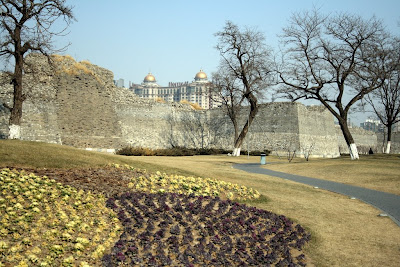
Ming City Wall Site Park


This photo is of a pretty little city park that contains the last remnants of the Beijing city wall. Chairman Mao ordered the entire wall torn down, and this is the last remaining piece, unfortunately; otherwise, it would be a wonderful tourist attraction today! Note the Marriott's odd architecture in the background.

Turing

While on vacation in China, I read Turing, by Christos Papadimitriou. The author is a computer science professor at Berkeley (whose theory textbooks are widely used), and this book is really a novel for programmers. Overall, it was an interesting read: it does a good job of explaining the many levels of software and hardware that comprise a computer system. As a novel, I was not so convinced: it tried to hard to be learned, the love story was unconvincing, and the basic mystery of how the Turing AI was created was not discussed.

Vere Chocolate

I bought some chocolate from Vere for Valentine's Day (before leaving for China, of course). They manufacture some wonderful chocolates: not too sweet, like most standard chocolates!

Captain Alatriste

I finished reading Captain Alatriste, by Arturo Perez-Reverte, while on vacation. It was an enjoyable and fast read: very reminiscent of Dumas' novels about the Three Musketeers. I would have like to have read this book in the original Spanish (if I could read Spanish, that is).
Highly recommended light reading!

Animal Liberation

I finished Animal Liberation, by Peter Singer while on a plane to China. The book presents a compelling argument as to why we should not eat animals. Although it is not the primary reason I am eating more vegetarian, it certainly lends philosophical support. I have found it difficult to entirely give up meat, especially when we were on vacation in China. I suppose that the primary reason for this is that our society has evolved to use meat as a means of displaying wealth, since meat used to be relatively rare. As a result, large celebratory meals often have a fair amount of meat. Since we were in China for Chinese New Year, we had several such meals!

Emotional Intelligence

I've been reading parts of Daniel Goleman's book Emotional Intelligence.
Wikipedia has an interesting discussion about this topic. Overall, it talks about a lot of commonsense stuff, but maybe that's easy to see in hindsight. Some of the claims in the book about how society was deteriorating seem completely overblown: the book implies that a lack of emotional intelligence was responsible for many societal ills.

Company

We saw Company, which is a great musical. It should win lots of awards! Each member of the cast sings and plays at least one instrument, modulo the lead and one other character. The music and songs were good (some were memorable), but they weren't extraordinary. Some of the actors were amazing, though. The singer who played the lead role (Bobby), Raul Esparza, has a wonderful voice. The singer who played the oldest female role (Joanne), Barbara Walsh, was simply stunning.

Nutrition information

Here's a useful table that summarizes how much information various restaurant chains provide online about their meals. Very interesting: I wouldn't have thought, for example, that Chipotle would do such a poor job.

Pan's Labyrinth

We watched Pan's Labyrinth, which was a beautiful film. I still can't figure out whether it was more of a fairy tale or more of a war movie. Of course, we Americans can't relate to the Spanish Civil War in the same way that Spaniards would, so such speculation is probably fruitless.

Rome

We watched some episodes of Rome. Interesting TV and full of political intrigue. The actor who plays Julius Caesar did not demonstrate the charisma that I would expect from Caesar; otherwise, I really enjoyed the show.

Personality strengths

Now, Discover Your Strengths is an interesting book about personality types---more accurately, personality strengths. It makes an interesting claim that everyone should focus on building their careers around their strengths, not on fixing their weaknesses. They have an online questionnaire that evaluates the top 5 strengths out of their universe of 34. Mine were:

  1. Learner

  2. Deliberative

  3. Responsibility

  4. Restorative

  5. Activator


I'm still mulling this over to see if this classification describes me well.

Climate

I watched An Inconvenient Truth, which was pretty good. But I thought the book was better, because I didn't have to listen to so many self-congratulatory platitudes. Interesting series of suggestions at the end, but I was annoyed that it encouraged the use of biofuels, which seem like an utter waste of resources.

The suggestion that Lake Chad has been destroyed because of global warming seems to be untrue, based on some of the reading that I have done.

Gore should have suggested that we eat less meat, buy fewer processed foods, and buy less stuff. The former consumes a great deal of energy (unless it is grass-fed), and I bet food processing does too. Finally, capitalism itself (more accurately, consumption for the sake of consumption) is responsible for a lot of the energy we consume, because all of the environmental damage is externalized. My conclusion is:

Consume less stuff. Consume less food. Consume less energy.

24

Well, another season of 24 has started. It literally started with a bang (a nuclear explosion). But it's degenerated into some really non-interesting stuff. Family squabbles for Jack (who barely appeared on-screen in yesterday's episode), political maneuverings in the bunkered White House, just not very good. Prison Break has been much more fun, if you want to watch complicated plots about the Presidency. Watching Jack Bauer torture his brother just isn't that fun.

Pesticides

My cousin Jack just pointed me at a post that he made about pesticides in food. Here's the link to the site, which rates which produce has more pesticides. Watch our for apples!

Another game

Yet another hilarious game, Oil God. It's made by Persuasive Games, the same company that made Bacteria Salad.

Recycling

Here's an interesting idea that probably works reasonably well in NYC: freecycling. It's like Craigslist, but giving used stuff away.

Amusing game

An article in the NY Times mentioned the game Bacteria Salad, which is hilarious (if not a very interesting game).

Michael Pollan article

Michael Pollan, author of The Omnivore's Dilemma, has an article
in this week's NY Times magazine. Well worth reading, even though its recommendations overlap with almost all of the other reading I've been doing about food. I love the opening sentences:


Eat food. Not too much. Mostly plants.

Silly food labels

We had some oatmeal this morning, and the box says "Helps reduce cholesterol". What a ridiculous claim: if you eat foods without cholesterol, then your cholesterol levels will go down. So every non-meat product could have that exact same label.

Vitamins

One of the organizations I learned about in What To Eat is Consumer Lab. They evaluate vitamin supplements; this is a valuable service, since no government agency regulates supplement makers. Most of the large corporations that manufacture supplements seem to be OK, but some of the smaller ones may produce supplements without all of the vitamins listed on the label. Even worse, some of the supplements may be contaminated with elements such as lead.

What To Eat

I finally got through What To Eat, an encyclopedic book about food: its marketing, health effects, and some about its environmental effects. Interestingly, the author also lives in NYC, so she talks about various groceries, delis, and restaurants here. More later...

Serenity

We've been watching all of the episodes of Firefly, and finally got around to the movie Serenity. The movie was kind of predictable in certain ways, but was fun to watch. I enjoyed the episodes a bit more than the feature film, because the episodes focused more on the characters. But it was interesting to see the film deal with some of the politics in the 'verse of Serenity.

The Met

From Around NY

Busy museum day. We went to the Met and saw two exhibits:


Both of them were amazing!

Cooper-Hewitt

We saw the Design Life Now exhibit at Cooper-Hewitt. Cooper-Hewitt is in a lovely building, and the exhibit had all sorts of interesting stuff. There were some novel designs for prescription drug bottles from Target (which is a sponsor of the Design Museum) that were really done well. There was even an exhibit on Google!

More garbage

Gone Tomorrow: The Hidden Life of Garbage is also a documentary; you can see it on Google Video.

Garbage

Gone Tomorrow: The Hidden Life of Garbage by Heather Rogers is a fascinating book about how the costs of capitalism have been externalized as waste.

She gave an interesting interview that is worth reading.

al-Qaeda

The Looming Tower is a fascinating book that describes the rise of militant Islam and al-Qaeda. It is frightening how the FBI and CIA bureaucracies rendered each other useless in the runup to 9/11. It is also amazing how well-educated the members of al-Qaeda are: alienation is a powerful force.

Lawrence Wright wrote a New Yorker article this is worth a read.

MOMA

We took a quick trip to MOMA, and saw a few exhibits: the retrospective on Brice Marden's work, Manet and the Execution of Maximilian, and OMA in Beijing. I must be too practical or just uneducated, but Marden's work was just not that interesting. Some of his later work is beautiful, but his earlier work did not move me. Manet's paintings were fascinating, but I also didn't find the subject matter that compelling. The OMA exhibit (which is about the construction of the China Central Television complex) was really interesting, though. I guess that I am just more interested in how art interacts the real world, rather than just abstraction for the sake of abstraction.

Seafood

I just found about the Seafood Choices Alliance, which publishes the Fish List: a list of fishes that we should or should not eat, based on environmental and health concerns.

Match Point

We watched Match Point, Woody Allen's latest film. I thought Crimes and Misdemeanors was a far more interesting film. This film seemed a lot shallower, and not as interesting. It was not a boring or bad film, just not great.

My first reaction after seeing this film: is Woody Allen working on some guilt because he killed someone? Why has he made two films about murder and guilt?

The Voysey Inheritance

We saw the Atlantic Theater Company's production of The Voysey Inheritance. The play has been adapted by David Mamet; it would be interesting to know what he changed in the play. The production was really enjoyable, in an intimate theater with a luscious set. It was definitely worth seeing!

Xi'an

We are thinking of visiting Xi'an (formerly Chang'an) in China. During the Tang Dynasty (8th century AD), Chang'an had a population of 2 million people!

Pinkberry

We walked by Pinkberry, a fancy dessert place in Koreatown. It looked very sleek and modern: as far as we could tell, it was a fancy frozen-yogurt place.

Electronics recycling

The
Lower East Side Ecology Center
and Con Edison sponsor a recycling event every year in Union Square. Time to finally get rid of that old computer!

Money mistakes

I skimmed through Why Smart People Make Big Money Mistakes & How To Correct Them, by Gary Belsky and Thomas Gilovich. It's an interesting book about behavioral economics, and how some common irrationalities that we all exhibit can affect our behavior with money. Some of the issues:

  • We tend to keep separate mental accounts for our money; don't let these mental accounts affect your spending patterns.

  • Losses affect us more than gains hurt us, so we get more reckless in trying to avoid losses.

  • Sunk costs do not matter.

  • We are affected by how issues are framed: reframe issues so that you see them both as gains and losses.

  • Don't ignore small numbers, such as mutual-fund fees.

  • We tend to anchor on irrelevant information, and we treat events that are likely to be the result of change as non-random; don't pay attention to such irrelevant information.

  • Don't be overconfident about your abilities if you have little training.

  • Avoid "confirmation bias", which is our tendency to treat information as though it confirms our decisions.

  • Don't follow the herd.

  • Avoid too much information. Information can cause us to act emotionally.

Little Miss Sunshine

Little Miss Sunshine was a disturbing movie that had some outrageous laughs in it: I almost died at the very end (which I will not give away). It is definitely worth watching!

Happy New Year

And NY gets a new governor, Eliot Spitzer. His inaugural address is nice; let's hope he can achieve some of his goals!

My Chemical Romance

I heard My Chemical Romance sing their hit single Welcome to the Black Parade on Saturday Night Live a few months ago. I found myself intrigued by the song, and was reminded of it tonight when I heard it several times used in a commercial for something on TV (I can't remember for what, amusingly enough). I haven't actually listened to any "modern" rock for a long time (the last time was when my cousin and then roommate Jack was playing Nirvana in our apartment), but I may go out and buy this album.

Rules of the Game

We watched Rules of the Game, which is a translation of a play by Luigi Pirandelli, a Nobel prize-winner in Literature. Interesting play, and very well written.

Ardneh's Sword

I quickly skimmed through Ardneh's Sword, by Fred Saberhagen. This book is a 17-year-later sequel to
Empire of the East. I loved the latter when I read it as a teenager, but Ardneh's Sword was really bad. As far as I could tell, the only reason for its existence is to tie the Empire of the East universe to the universe of the Twelve Swords. I'm glad I took this book out of the library, and didn't actually buy it.

Wealth

Wealth is by Stuart E. Lucas (a descendant of the founder of the Carnation company). I've been reading this on and off for the last month; it is an interesting book. The author's family has a lot of money, and he talks about the challenges of managing it. The interesting parts for those of us with less money:

  • He advocates index investing for almost all investors.

  • He suggests viewing one's career as a form of investment that can be used to balance passive investing.

  • He views the government as a "silent partner" in one's investing. The government actually takes more of the burden when one realizes losses, and only shares in gains. This is an interesting view of capital-gains taxes.


He talks about some of the interesting challenges of raising children (especially in the context of a great deal of money). Some of the more generally applicable pieces of wisdom: "fair does not mean equal", and good parents try to help their children realize their own personalities.

The Devil Wears Prada

The Devil Wears Prada was pretty funny. Meryl Streep was brilliant! The movie was fairly predictable, of course.

Firefly

We watched some episodes of Firefly this week. It's a fun series; too bad Fox didn't have the vision to keep running it.

Fragile Things

Neil Gaiman's Fragile Things was a pretty good read. There were some stories I did not particularly like, but there were also some wonderful ones. "A Study in Emerald" was a pleasure to read (Sherlock Holmes meets Chthulhu), and it deserved the Locus Award that it received. "October in the Chair" also deserved its award; for some reason it reminded me of Zelazny, although not in any obvious way.

Reds

We watched Warren Beatty's Reds, which I had never seen before. Great movie! And it certainly has relevance today, after our government has dragged us into a war that many people thought was unnecessary.

Influence

Influence
by Robert Cialdini is an interesting book. It talks about how we are all subject to basic human psychological pressures. The wikipedia entry on Cialdini summarizes the result pretty well: here is my one-liner summary:

  • Reciprocation. Tactics used: unequal exchanges (free samples), rejection then retreat (propose an extreme position then retreat).

  • Commitment and consistency. Tactics used: induce a small commitment to a particular image (ask for help with some trivial task).

  • Social proof. Tactics used: create illusory consensus ("man-on-the-street" endosrements).

  • Liking. Tactics used: good-looking salespeople, compliments, mirroring, sell through friends (Amway).

  • Authority. Tactics used: false titles (ads from authority figures without expertise).

  • Scarcity. Tactics used: time pressure, create false competition.

Vegetarian food in Flushing, NY

We ate at a vegetarian restaurant called Happy Buddha. The food was reasonably good: I wouldn't call it great, but I was happy enough to eat it.

Mystery Men

Mystery Men was, predictably, one of the worst movies I have ever seen. I just had to watch it, even though I knew it would be bad. It's weird how we humans can be silly.

I used to think Ben Stiller was funny. Now I'm not so sure. Zoolander was another bad movie that I forced myself (and my wife) to watch a few years ago, and it wasn't particularly good.

Fear: we really need to fear the media and politicians

I've been slowly reading The Culture of Fear, by Barry Glassner, over the last month. It's a somewhat interesting book, but not interesting enough to read that carefully. Distilled into my philosophy: do not trust anyone who has a vested interest in getting you to listen to them. This applies to the media and to politicians. The media want you to watch their news shows/read their newspapers, and the only way to do that is to create a sense of urgency. Politicians want to get elected or re-elected, and the only way to do that is to convince people that there is a problem that they can fix: even if the problem is not a real problem.

Water and food

Some of the startling statistics about water in When the Rivers Run Dry, written by Fred Pearce:

  • 25 gallons to produce a portion of rice

  • 40 gallons for the bread in a sandwich

  • 130 gallons for a two-egg omelet or mixed salad

  • 265 gallons for a glass of milk

  • 400 gallons for ice cream

  • 530 gallons for a pork chop

  • 800 gallons for a hamburger

  • 320 gallons for a small steak

  • 50 cups for a teaspoon of sugar

  • 37 gallons for a cup of coffee

  • 66 gallons for a glass of wine/beer

  • 530 gallons for a brandy

  • 1200 gallons (assuming 50 gallons/bathtub) to grow 9 ounces of cotton


Pearce talks about the relative water consumption of various human activities:

  • drinking: 265 gallons (1 ton)/year

  • home use: 50-100 tons/year

  • food and clothing: 1500-2000 tons/year


That makes clear that the bottleneck is clearly food and clothing, and that becoming vegetarian might actually be the best way to conserve water.

While I was walking home last night, I came to the minor realization that if we treat the human-earth relationship as a complex system, then some resource will always be the bottleneck. Pearce's book implies that it as water; the more obvious candidate (from a public perspective) has been energy (oil).

Water conservation

I've been reading When the Rivers Run Dry. An utterly frightening book about how humanity has done a bang-up job of ruining many ecosystems, and how we are utterly dependent on water in ways that most of us do not comprehend.

An interview with Fred Pearce, the author, sums up most of the issues discussed in the book.

Safran

Safran
is a good restaurant in Chelsea. We had sole, a bouillabaise, and sauteed chive flowers. They had a good selection of vegetarian entrees, and the dessert we had (sorbet with a white chocolate covering) was quite tasty. Thumbs up!

Sichuan food

Grand Sichuan is our favorite Chinese restaurant in Manhattan. Very tasty stuff!

Jonathan Coulton

Code Monkey was on NPR this morning, as part of an interview with Jonathan Coulton. He recorded a song per week. Pretty amusing!

William Bernstein

The Intelligent Asset Allocator is another worthwhile book to read about how to allocate financial assets. As with all sensible books, it recommends:

  • Diversification

  • Regular rebalancing to a fixed allocation

Thesis writing

Apparently you can buy anything these days, even a thesis! What has the world come to....

Deadwood

Deadwood is an HBO series that we are watching on DVD. We saw the first episode a few nights ago, and it was quite good!

Mindset

Mindset, by Carol Dweck, is a fascinating book about how one perception's of human abilities strongly affects one's ability to perform. It agrees with some of the research that I've heard about with respect to minority students, where students who are reminded of the stereotypes of their race perform more like the stereotypes. It's kind of scary how easily we humans can be manipulated, even unconsciously by ourselves!

Hoop Dreams

Hoop Dreams is a fantastic documentary from the early 1990's about two boys growing up in Chicago who were very good basketball players, and their experiences in high school. It is very moving, and Roger Ebert even called it the best film of the 1990's.

Here is a Washington Post article that talks about the two protagonists in 2004.

Google Analytics

Google Analytics is pretty neat. I instrumented my blog and home page with it so that I can measure if there is any interest in reading it. Curiously, I'm getting a few hits a day! If you're one of those readers, welcome.

The Iraq Occupation

The Prince of the Marshes by Rory Stewart is an excellent read, and summarizes the differences between incompetent bureaucrats and relatively effective administrators. I loved the quotes from Machiavelli that introduced many of the chapters. This book was particularly good because it was written by a Brit: he has a far greater understanding of history than most of us Americans.

Too bad the Bush administration didn't understand (and maybe still doesn't understand) that effecting governmental change takes a skilled bureaucracy and not just propaganda.

revolution in string instruments

NY Times article on modern string instruments

Fascinating. I wonder what it would be like to play on one of these instruments?

After the Thin Man

After the Thin Man was quite entertaining. Netflix is an excellent way of getting a hold of these old movies!

Scooby Doo!

From Around NY


We went to see the Macy's Thanksgiving Day Parade balloons the night before the parade. It was quite fun, and there must have been tens of thousands of people there! Scooby Dooby Doo!

The Thin Man

The Thin Man was recommended to us by my friend Sanjay. Excellent film! The dialogue had a modern feel, much like His Girl Friday. And as a bonus, it was set in New York City.

dessert

We walked by a fascinating dessert place: Rice to Riches. They serve rice puddings! It was quite crowded in the store. If we hadn't been so full from dinner in Chinatown, we would definitely have tried some of their pudding.

There is a limit of 500 rice puddings per customer.

Asia Society

We went to see an exhibit on the Liao Dynasty at the Asia Society Museum. Yet another museum with free admission on Friday nights in New York! An interesting exhibit, if somewhat small.

The Asia Society Museum also had an exhibit of modern Asian-American artists, which I found to be pretty uninteresting.

One amusing item: there was a piece by a Hong Kong artist named Wilson Shieh!

Zabar's

We finally made it to Zabar's. It was utterly packed; there's almost no room to wander around in there! Quite a selection of interesting food.

Little Manhattan

We watched the movie Little Manhattan. Pretty good story about childhood infatuation/love, told by a adult-voiced child.

squash

Here's a great web site with videos of squash matches. Fantastic playing!

Jonathan Strange

I tried to read the massive tome Jonathan Strange and Mr. Norrell, but it was just too dry. It is imaginative and fascinatingly detailed, but it just did not grab me.

Infernal Affairs

Infernal Affairs is the Hong Kong B movie upon which Martin Scorsese's new movie The Departed was based. We watched this tonight, and it was not that good: however, the ending was a better ending than that of The Departed.

Chamber music

Music at Marlboro played at the Met. Outstanding concert: the performance of Brahms' songs for mezzo, viola, and piano, was truly magnificent.

Lily Francis, violin
Miho Saegusa, violin
Eric Nowlin, viola
Katie Kadarauch, viola
Marcy Rosen, cello
Ieva Jokubaviciute, piano
Tamara Mumford, mezzo-soprano


Beethoven—Folk Songs for Voice, Violin, Cello, and Piano
Brahms—Zwei Gesänge, Opus 91 for Mezzosoprano, Viola, and Piano
Bartók—String Quartet No. 4
Mozart—String Quintet in D Major, K. 593

Tamara, Ieva, and Eric performed the Brahms. The rest of concert was quite impressive (the Bartok 4 was sparkling), but the Brahms is the performance that I will remember.

Narnia

The Lion, The Witch, and the Wardrobe was a mildly entertaining movie. But it certainly was not that good a movie. Perhaps if I were as young as I was when I read the book, I would have enjoyed a great deal more.

Stephen Brust

I managed to read through Dzur. Overall, it is an entertaining book, but after waiting so many years for this series to continue, it was also somewhat of a disappointment. Too little payoff (too few questions answered), and too many questions added.

Vegetarianism

I managed to finish Peter Singer and Jim Mason's book The Way We Eat: Why Our Food Choices Matter while on an airplane to CA. It's a very disturbing book, and is a good followon to The Omnivore's Dilemma. I've been trying to shift my diet away from meat, and this book provides a lot of good reasons why I should try and continue.

Everything is Illuminated

Everything is Illuminated

This movie was pretty good! It had some wonderful moments, although it also felt very slow at points. It was weird to see Frodo, and the moment where he is given his grandfather's first wife's wedding ring was just too funny! I wouldn't have cast him in that role, just to avoid that moment of hilarity.

Fooled by Randomness

Fooled by Randomness, by Nassim Nicholas Taleb

I read through this book quickly. Interesting philsophically, but it rambles and doesn't get to any points, other than to attempt to impress the reader with the depth and breadth of the author's reading.

Bouchon Bakery

We went to the Bouchon Bakery, which has some great pastries. It is run by Thomas Keller, one of the most famous chefs in the US. Yummy!

International Center for Photography

The ICP had a show called Ecotopia. Friday nights are free, which is good, because the museum isn't that large. We spent an hour looking at the photos and videos, some of which were reasonably compelling.

The Kite Runner

The Kite Runner, by Khaled Hosseini

I finished this book today while waiting for our car to get repaired. Quite a good read, with some very moving passages; I felt like weeping several times in the book. I recommend the book highly: the only weakness was near the end, when the events of a decade were telescoped down into a few dozen pages, and there was a little too much use of flashback.

The Departed

The Departed

What an excellent movie! Not sure what else to say: good writing and acting. Leonardo di Caprio was fun to watch, as was the rest of the fine cast.

The City of Falling Angels

The City of Falling Angels

Over vacation I listened to this book on tape. Fascinating story about Venice and a lot of fascinating Venetians.

Interesting art at the Met

From Around NY


We went to the Met today and saw some interesting exhibits. One was of art that passed through the art dealership of Vollard. Another interesting work in the exhibit of Chinese calligraphy was this piece. Can you read it? Hint: the plaque at the bottom of the photo tells you what it says.

Larry Swedroe

What Wall Street Doesn't Want You to Know,
Rational Investing in Irrational Times,
The Successful Investor Today.

Interesting books that I've been reading over the last few weeks, although they all effectively say the same thing.
A few points of note:
1. Swedroe indicates that one should not use bond funds. It is not clear if means that investors should avoid actively managed bond funds, or whether they should avoid all bond funds. One of the arguments that Swedroe makes is that you may lose principal value in a bond fund, but the academic literature indicates that principal doesn't matter: it is the income stream that it generates. In addition, rebalancing while holding individual bonds can be difficult while maintaining the desired maturity. Vanguard article on these issues.

2. Swedroe indicates that one should invest in short-term bonds (duration about 1 year). This may conflict with what David Swensen says about bonds, which is that one holds treasury bonds to protect against deflation/economic disasters. Short-term bonds do not provide as much protection against deflation as intermediate-term bonds.

Food

We ate the Hampton Chutney Company and Room 4 Dessert tonight. The Chutney Company has some interesting non-traditional dosas. We had one spiced potato dosa, which seemed authentic (at least to my palate), and one portobello mushroom dosa, which is certainly an interesting take. We enjoyed it a great deal.

Room 4 Dessert is a fascinating little dessert bar. Each dessert is over 10 dollars, and the one we had was a tiny little glass with coconut juice, black sesame gelato, and a raspberry mousse. Interesting, but a little too expensive to go frequently.

Mutual fund costs

Mutual fund real cost calculator

This calculator gives investors a great way of evaluating how efficient their mutual funds are. Most are not!

Climate change

An Inconvenient Truth

Al Gore's book is frightening: in particular, the pictures that show how much glaciers have receded in the last quarter-century. I remember going to Glacier National Park 10 years ago, and there seemed to be lots of snow; but certainly less than was shown in the pictures from the 1970's.

Outsiders

Outsiders, directed by Francis Ford Coppola

We watched this film over the weekend. Interesting movie, especially given all of the big-name movie stars that appeared in the film. Ming liked the movie better than I did, I think; I found it a little overly sentimental/melodramatic. Still, it was entertaining.

Tales of the City

Tales of the City

Since Ming likes San Francisco so much, I thought she would enjoy watching this series. We've been watching bits and pieces of the first DVD and finally finished it today. I read these books many years ago, and I have to admit that I don't remember any of the story.

Marriage


What Shamu taught me about a happy marriage


I read this article a while ago, and just heard an interview with the author on WNYC this morning on the Brian Lehrer show. Apparently this article is the most emailed article in the NY Times.

ETFs

ETF guide

This web site is pretty informative about how to use ETFs for investing. One problem I have with a lot of web sites that talk about ETFs is how it talks about tax loss harvesting every year. If I read these sites correctly, they suggest various ways to get around wash sale rules: it seems to me that anything that tries to maintain the same level of risk and still get around the tax code verges on being declared illegal by the IRS.

Corpse Bride

Corpse Bride

This film was short and entertaining, if a little predictable at the end. I was amused by all of the cinema references. I can only remember two:

  • Remains of the Day

  • Victor, Victoria

Bogle on capitalism

The Battle for the Soul of Capitalism

Interesting book about how corrupt corporations and the financial services industry have become. Bogle's thesis is that both corporations in general and the financial services industry in particular have stopped doing their fiduciary duty, and instead are exploiting their control (as managers) over money. Given the excesses of the last few years, it is hard to argue with him.